How HyperCommute Learned to Think in Real Time — From Aircraft Logistics to AI-Powered Mobility Orchestration
Long before agentic AI became mainstream and intelligent orchestration entered enterprise conversations, we were solving a problem that demanded both.
The setting was one of the world’s most operationally demanding environments:
Aircraft maintenance logistics.
At Lufthansa Technik facilities in Frankfurt and Hamburg, aircraft parts needed to be picked up and delivered across highly constrained airport environments where timing mattered, delays were costly, and operational precision was critical.
Every missed pickup could impact downstream maintenance schedules.
Every routing decision had consequences.
And every operational constraint mattered.
The challenge was ambitious:
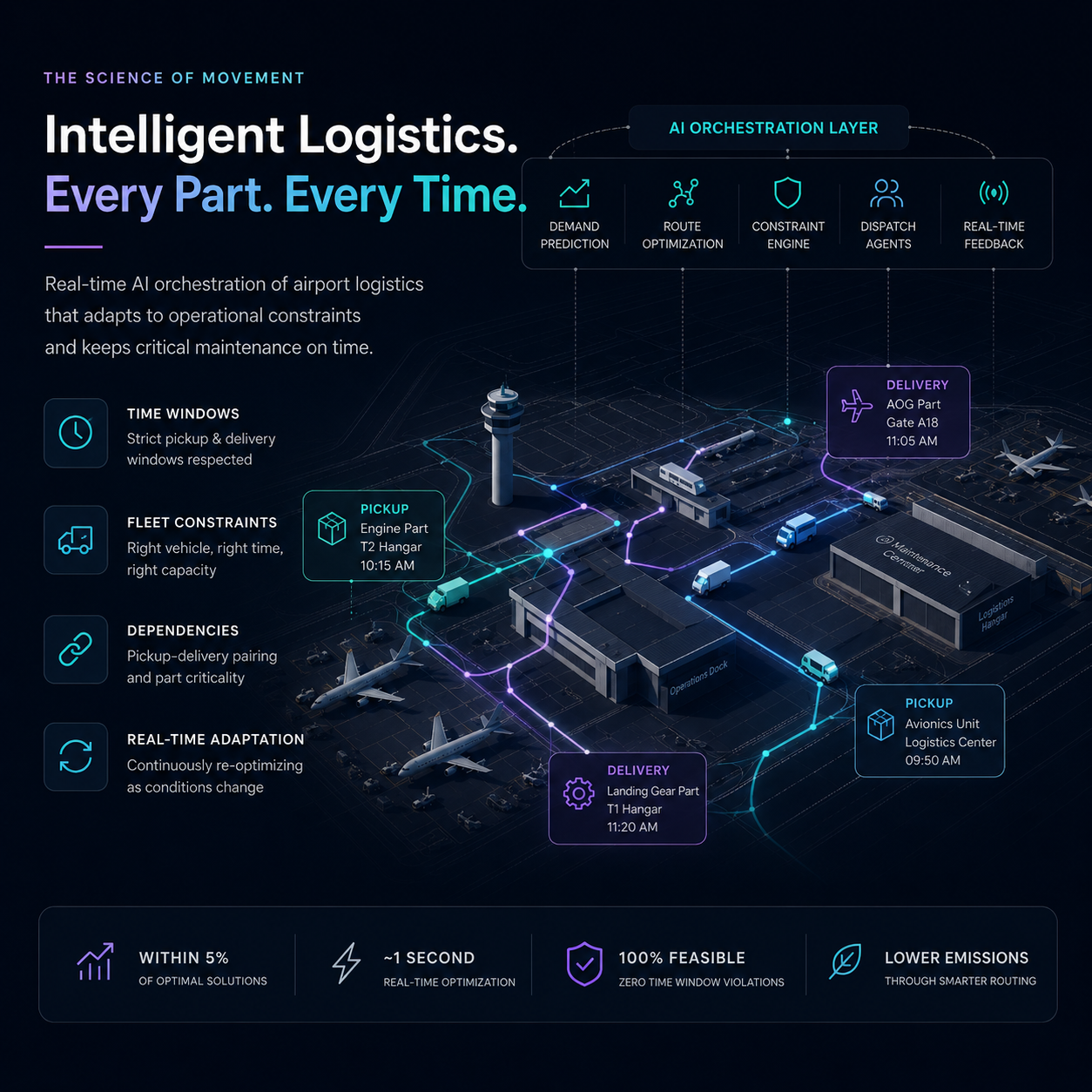
Build a real-time logistics intelligence system capable of coordinating pickup and delivery operations under complex operational constraints — while achieving near-optimal performance fast enough for live execution.
At first glance, this looked like a routing problem.
In reality, it was something much bigger.
It was an orchestration problem.
Every decision had to simultaneously balance:
- strict time windows
- pickup and delivery dependencies
- vehicle capacity and availability
- operational feasibility
- changing priorities
- route efficiency
The search space was enormous.
At every decision point, millions of possible combinations existed.
Research benchmarks at the time demonstrated strong theoretical approaches, but translating those ideas into something fast enough for operational reality remained difficult.
The target was demanding:
Reach within 5% of optimal solutions on benchmark routing problems involving 100 pickup-delivery requests and 10 vehicles — within 60 seconds.
For live airport logistics, speed mattered as much as accuracy.
When optimization alone stops working
The obvious answer was to search harder.
We implemented increasingly sophisticated optimization strategies, experimenting with multiple neighborhood search approaches and route improvement techniques.
The system improved.
But not enough.
The search space exploded into millions of candidate moves.
The algorithm repeatedly plateaued in local minima.
Computation increased.
Performance gains diminished.
The experience revealed an important truth:
Real-world operational systems do not reward endless optimization.
They reward fast, confident, operationally useful decisions.
So we stopped asking:
How do we search more?
And started asking:
How do we think better?
The breakthrough: intelligence before optimization
Instead of focusing solely on algorithms, we began studying the solutions themselves.
Patterns started to emerge.
High-performing routes consistently displayed natural spatial clustering.
Movement was not random.
Operational constraints created invisible geographic patterns.
The best solutions were quietly organizing themselves around the physical structure of movement.
That insight changed everything.
Instead of forcing optimization algorithms to rediscover those patterns repeatedly, we redesigned the system to understand them upfront.
We introduced intelligent preprocessing and spatial awareness into the routing process.
In effect, the system learned to understand the environment before making decisions.
The impact was dramatic.
What previously required minutes of computation suddenly converged in approximately:
Fast enough for real-time execution.
Reliable enough for operational deployment.
Flexible enough for complex transportation environments.
But the most important lesson was still ahead.
Designed to fit operations — not force them to change
Optimization systems often fail for a simple reason:
They expect operations to adapt to software.
Real operations do not work that way.
Airport logistics evolve continuously.
Vehicles become unavailable.
Urgent priorities emerge.
Human dispatchers intervene.
Business rules change.
Teams operate differently.
A mathematically elegant solution that cannot fit operational workflows becomes difficult to sustain.
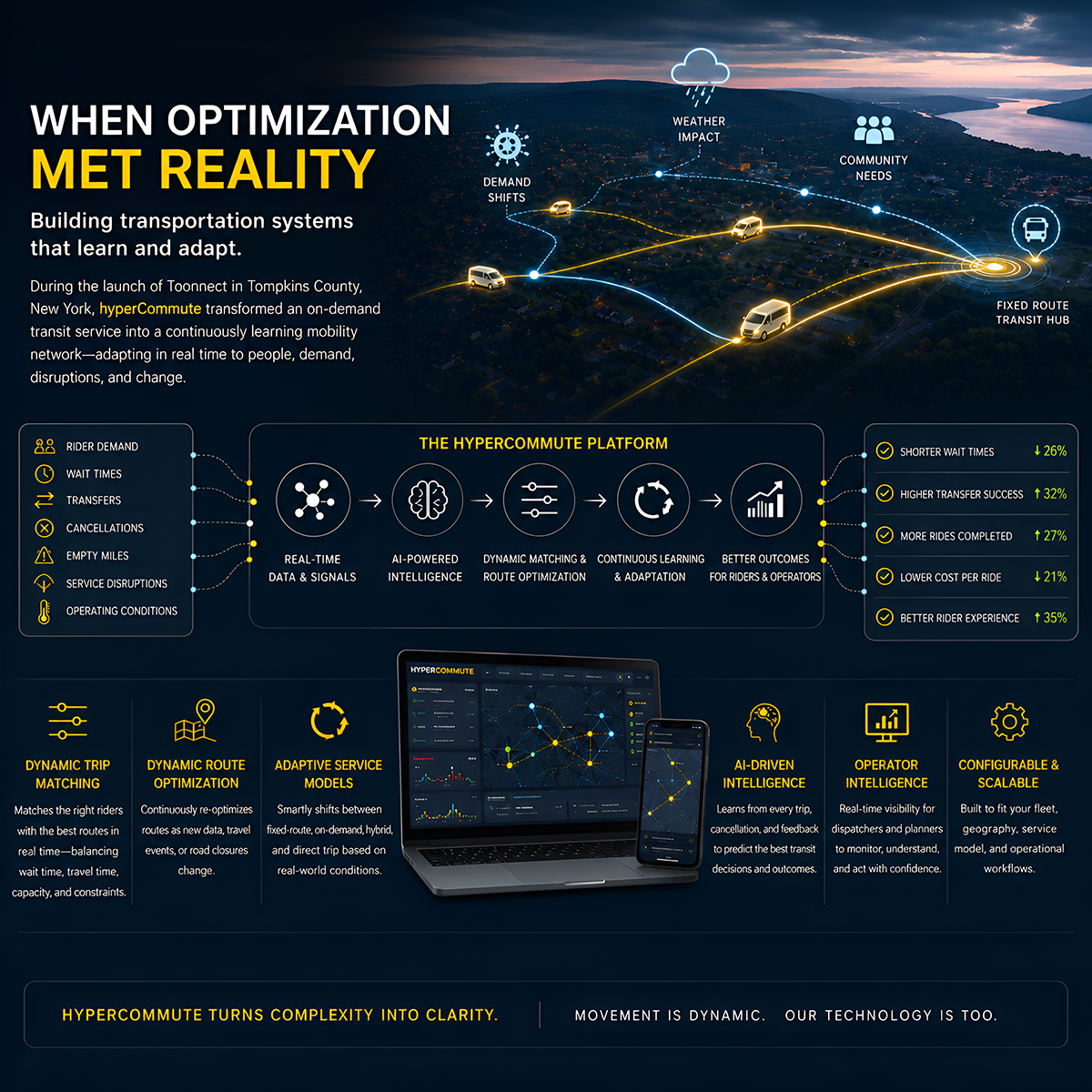
From the beginning, the intelligence was designed not simply as a routing engine, but as an adaptive operational layer.
The goal was not to replace operational workflows.
It was to strengthen them.
The system was built to:
- adapt dynamically to changing priorities
- fit into existing operational processes
- support human decision-making during exceptions
- continuously rebalance routes in real time
- incorporate business rules without redesigning the system
Instead of forcing teams to change how they work, the technology learned to work with operations.
That principle became foundational.
Because transportation systems are living systems.
No two environments behave the same way.
No two cities move the same way.
No two operators solve problems identically.
Which means transportation intelligence must be:
adaptive, configurable, explainable, and operationally aware.
Why this matters in the era of AI agents
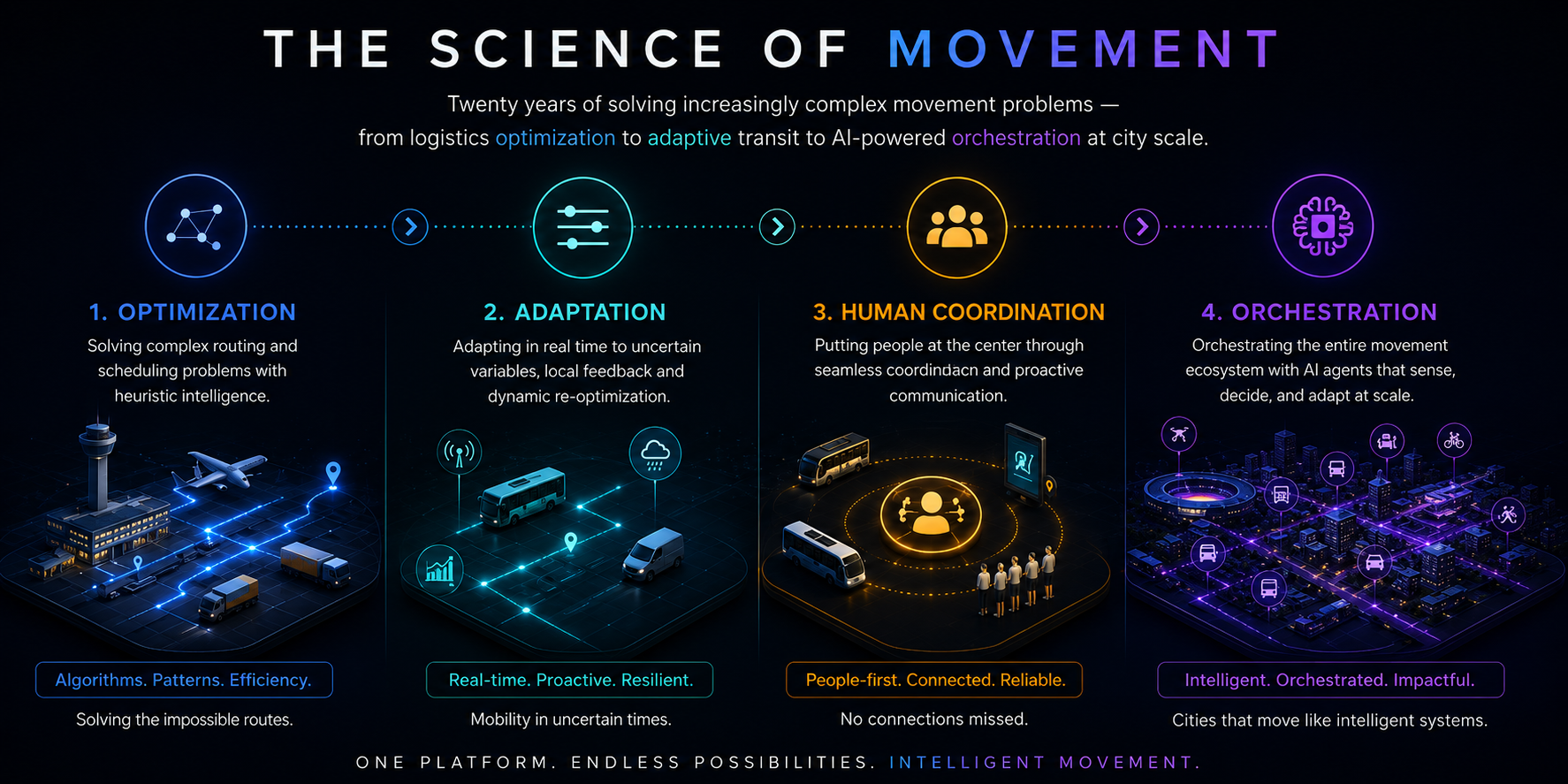
Today, transportation is entering a new phase.
Advances in AI, simulation, and agentic systems are redefining what intelligent mobility can become.
The future is no longer static route optimization.
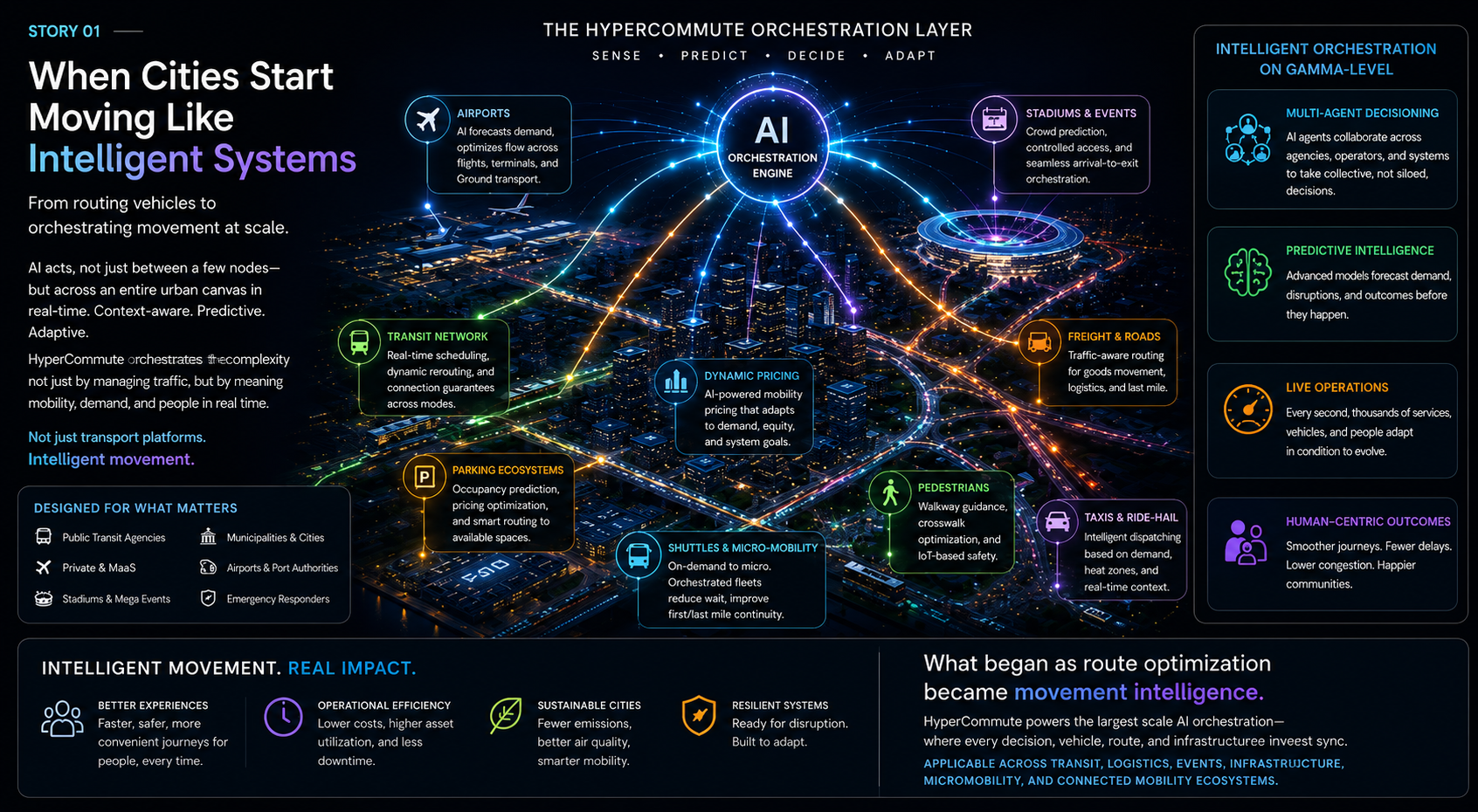
It is AI-powered orchestration of movement at scale.
A world where specialized AI agents continuously coordinate:
- rider demand
- fleet availability
- traffic conditions
- transit synchronization
- parking systems
- service disruptions
- customer communication
- safety and operational priorities
Transportation systems are becoming dynamic, adaptive ecosystems.
In many ways, this resembles a digital operating system for cities and mobility networks.
But the promise of AI only works when intelligence can seamlessly fit into how operations actually function.
The best AI systems are not the ones that replace people.
They are the ones that:
learn, adapt, coordinate, and amplify operational decision-making.
At HyperCommute, this belief continues to shape how we think about movement.
From aircraft logistics to public transportation, first-mile/last-mile systems, youth mobility, and mega-event orchestration, the challenge remains remarkably consistent:
How do you coordinate movement intelligently in environments that never stop changing?
The answer has never been brute force.
It has always been understanding movement itself.
Because great transportation systems are not built by optimizing harder.
They are built by understanding movement better.